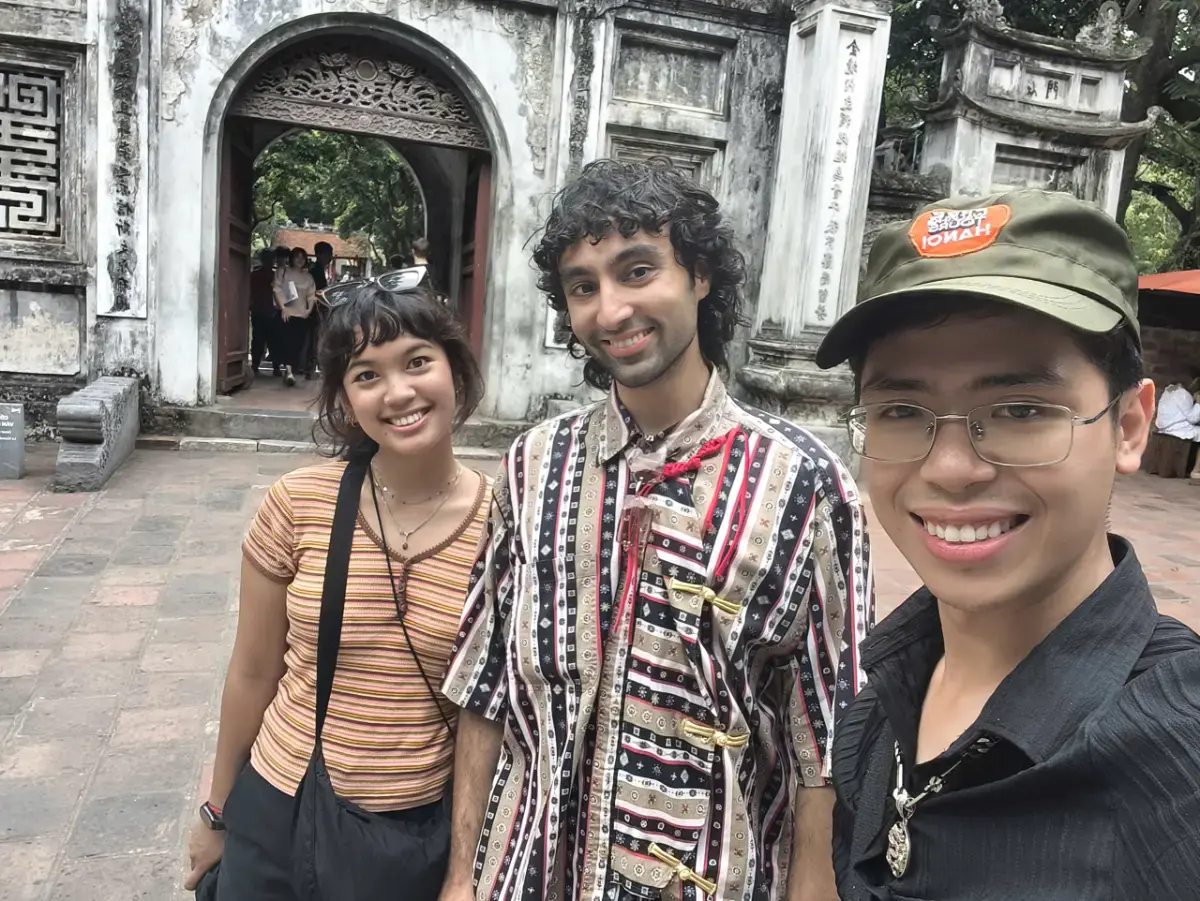
From the road, Hanoi's Temple of Literature can feel almost too orderly for the city around it: a sequence of gates, ponds, trees and tiled roofs behind a long wall. Step through, though, and the order starts to read less like decoration than an idea. This was a place made to give learning a visible place in the life of the state — a place where study, conduct and public service were meant to belong together.
The complex was founded in 1070 under the Ly dynasty as a temple honouring Confucius. The Imperial Academy followed in 1076, creating the institution commonly described as Vietnam's first national university. That description is useful, but it should not make the site sound like a modern campus dropped into the past. It was a ceremonial and intellectual world with its own hierarchy, rituals and ambitions. For practical information about timing, access and a respectful visit, use the Temple of Literature place guide; this journal is for the slower story behind the gates.
A walk through an argument about learning
The five courtyards lead inward along a central axis, but they do not simply lead to a single grand reveal. They change the pace. Early gates and gardens create a threshold from the street; the Khue Van Pavilion frames the approach to the scholars' memorials; the inner spaces turn toward ritual and teaching. A visitor does not need to identify every roofline to feel the progression from arrival to attention.
Confucian learning in this setting was not only about mastering texts. It tied education to moral cultivation and the duties of administration. The ideal scholar was expected to read closely, behave responsibly and serve well. That is why the site carries both the calm of a temple and the institutional gravity of a school. It remembers study as something with consequences beyond the individual student.
Much has changed across the centuries: dynasties ended, buildings were repaired or rebuilt, and educational systems moved on. The value of the complex is not that it offers an untouched medieval scene. Its value is that it preserves a continuing conversation about what a learned life should mean.
Names that were meant to last
The most direct encounter with that conversation is the collection of stone stelae carried on turtle backs. Eighty-two surviving stelae record the names and home districts of men who passed the royal examinations between 1442 and 1779. They are not generic symbols of scholarship; they are a public record of particular people who succeeded in a demanding system.
The turtles are easy to notice, but the writing is the point. The inscriptions recognise achievement while also addressing future candidates, rulers and officials. They make a practical claim: talent matters, education needs care, and those entrusted with office should remember how they arrived there. The stelae were inscribed across different periods, so they hold both individual names and a long institutional memory.
In 2010, the doctoral stelae were inscribed on UNESCO's Memory of the World Register. That recognition applies to the documentary heritage of the inscriptions, not to a UNESCO World Heritage Site designation for the entire complex. It is a small distinction, but it helps keep the story precise.
Why the courtyards still matter
It is tempting to move through the Temple of Literature as a list: gate, pavilion, well, stelae, hall, photograph. The complex gives more back when you resist that rhythm. Pause at the threshold of each courtyard. Notice how sound changes, how the trees frame the paths, and how a view opens only after a turn. The site was designed around sequence and reflection, not instant spectacle.
The Well of Heavenly Clarity and the rows of stelae sit within this measured architecture of water, stone and enclosure. They create a different kind of historical encounter from a museum label. You see names worn by time, beside visitors who may be taking graduation photographs or bringing children to look at the turtles. The past is not sealed off; it remains a reference point for contemporary hopes.
This is also why respect is more useful than performance here. Keep clear of ceremonial spaces, give students and worshippers room, and do not turn a quiet corner into a prolonged photo set. The visit becomes richer when you let the place keep some of its ordinary dignity.
Graduation photos, exam visits and courtesy
You may see students in formal dress photographing one another beside the stelae or Khue Van Pavilion, especially around graduation season. Treat those moments as private milestones, not as a backdrop for unrelated poses. Step aside before adjusting your camera, keep voices low near study groups, and follow any temporary barriers or staff directions.
The Temple of Literature place guide carries access and timing notes that change more often than this story-led article. Pair that hub with the Hanoi City Tour if you want guided pacing between Van Mieu and other western landmarks rather than a rushed self-guided crossing.
A living symbol, not a frozen lesson
For many Vietnamese visitors, the Temple of Literature still speaks to the pressure and promise of education. Students come before exams, graduates return in formal dress, and families bring younger children to a place associated with effort and possibility. These scenes can be photogenic, but they are also reminders that the site's ideas have not become merely historical.
Place it within a wider Hanoi day rather than squeezing it into a sightseeing race. The Hanoi on foot guide explains why the western landmarks work best as their own chapter, while First time in Hanoi helps put that chapter into a first-trip plan. The short ride from the lake is often a better choice than forcing a long, hot walk across the city.
After the final courtyard, returning to the street can feel abrupt. That contrast is part of the visit. Hanoi does not stop being noisy, fast or practical outside the wall; the Temple of Literature simply offers another measure of the city — one in which memory, learning and patient attention still have a visible home.