
Ha Giang Loop Tour
Four days through Vietnam's most dramatic mountain roads.
Some roads stay with you forever.
The mountains begin slowly. Beyond the busy streets of Hanoi, the roads narrow into valleys lined with rice fields, tea hills, and distant limestone peaks rising through the mist. Villages become smaller. Traffic disappears. The air cools as the roads begin climbing deeper into the far north of Vietnam. Then Ha Giang arrives.
For many travelers, the Ha Giang Loop becomes more than simply a road trip. It becomes a feeling — of freedom, movement, silence, and landscapes so immense they almost feel unreal. Over four unforgettable days, the journey follows winding mountain roads through towering limestone passes, deep river canyons, remote ethnic villages, cloud-covered roads, and centuries-old highland communities.
But the real beauty of Ha Giang is not only the scenery. It lives in the moments between destinations — tea with local families beside roadside homes, children waving from mountain paths, early morning fog drifting across stone valleys, quiet evenings in small villages after the roads empty. This is not a rushed sightseeing tour. It is a slow, immersive journey through the northernmost mountains of Vietnam — guided by people who know these roads deeply and travel them with respect.
Why travelers choose this journey.
Ma Pi Leng Pass & The Nho Que River
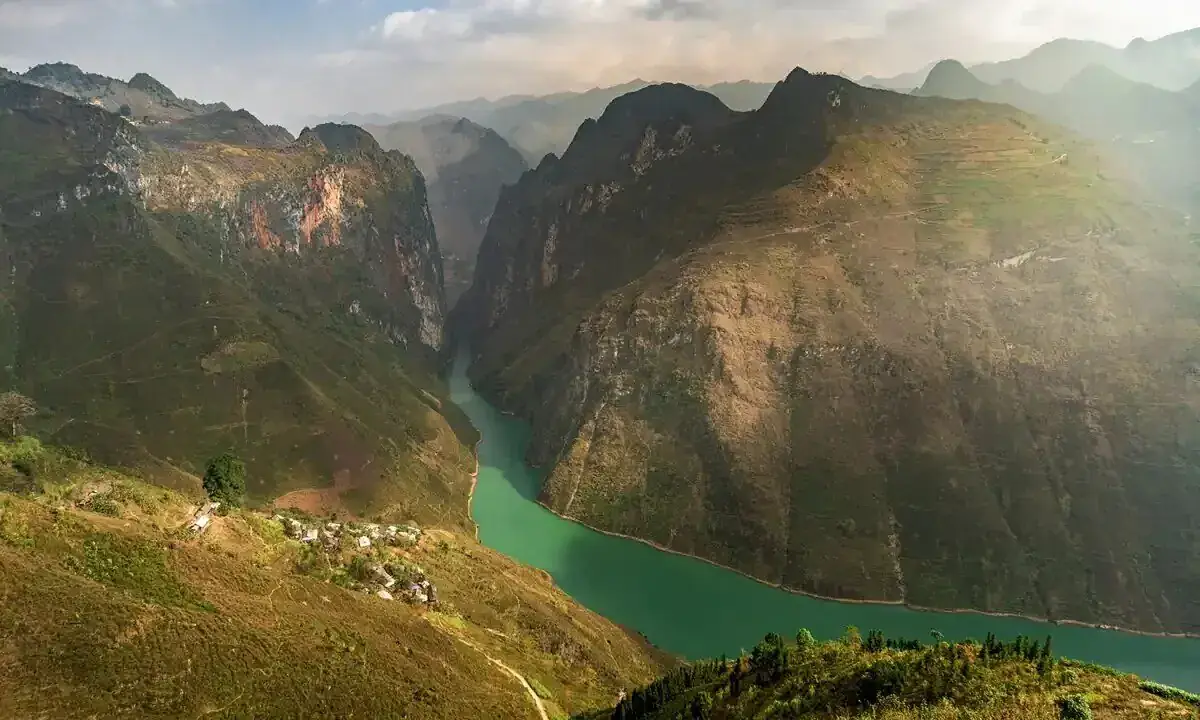
The road clings to the mountains high above the emerald Nho Que River. On clear days the canyon feels endless. In fog, the mountains disappear into cloud — cinematic and unreal. A boat through Tu San Canyon reveals the deepest section of the gorge.
Local Culture Beyond the Main Roads
Hmong, Tay, Dao, and Lo Lo families whose traditions remain deeply connected to the mountains. Stone houses, local markets, textile weaving, villages built into steep limestone valleys — not performances, just everyday life in the far north.
Evenings in the Mountains
After long hours on the road, dinner is shared family-style around warm kitchens. Rice wine poured slowly. Fog settling outside over the hills. Without city noise or bright lights, Ha Giang feels incredibly still after dark.
"The roads in Ha Giang are never only about reaching the next stop. The journey itself becomes the memory."— Mr. Duong, Northern Vietnam Mountain Guide
Four days through Vietnam's far north.
Hanoi → Quan Ba → Nam Dam Village
Leaving Hanoi in the early morning, the journey moves north through the Red River Delta before climbing into the Dong Van Karst Plateau Geopark via the dramatic curves of Bac Sum Pass. Panoramic views open at Quan Ba Heaven Gate across the Twin Mountains before arriving by late afternoon at Nam Dam, a peaceful Dao village of earthen houses, rice terraces, and mountain streams. Time to walk slowly through village paths and cross small suspension bridges before sharing dinner with the host family. Overnight in Nam Dam Village.
Nam Dam → Yen Minh → Tham Ma Pass → Lung Cu → Lo Lo Chai
A quiet morning in Nam Dam as mist and early light move across the terraced fields, followed by a journey deeper into the northern plateau — through Can Ty Pass, the Yen Minh pine hills, Tham Ma Pass, Sung La Valley, hidden Hmong villages, and the historic Hmong King Palace near Sa Phin. Lunch is served locally along the route before continuing toward Lung Cu near the Chinese border. By evening, arrival at Lo Lo Chai — one of the most atmospheric villages in the far north, known for its traditional earthen homes and quiet stone lanes. Dinner and overnight at a carefully selected homestay or boutique lodge inside the village.
Lo Lo Chai → Lung Cu → Dong Van → Ma Pi Leng → Meo Vac
A slow morning in Lo Lo Chai before continuing to Lung Cu Flag Tower at one of Vietnam's symbolic northernmost points. The route then returns toward Dong Van before climbing onto the legendary Ma Pi Leng Pass — widely considered the most spectacular mountain road in Vietnam, following steep limestone cliffs high above the emerald Nho Que River. On clear days, the scale of the canyon feels almost endless. In foggy weather, the mountains disappear completely into cloud. Weather permitting, a boat journey through the Tu San Canyon reveals the deepest section of the gorge. Dinner in Meo Vac and overnight at a mountain lodge.
Meo Vac → Mau Due → Du Gia → Ha Giang → Hanoi
A different return route to avoid repeating the previous roads — continuing through Mau Due and the quieter valleys surrounding Du Gia, one of the greenest sections of the loop. Winding roads pass waterfalls, rice terraces, Tay villages, and remote riverside countryside hidden between the mountains. After lunch along the route and a final rest stop near Ha Giang City, the private journey returns comfortably to Hanoi, arriving back at your hotel later that night.
Everything, arranged. Nothing that doesn't matter.
We work closely with local drivers, guides, homestays, and communities throughout Ha Giang — supporting local families and avoiding rushed mass-tourism itineraries.
- Private transport from Hanoi and return
- Experienced local easy rider or driver
- English-speaking mountain guide throughout
- Accommodation for 3 nights (homestays and mountain lodges)
- Meals during the journey
- Entrance fees and permits
- Nho Que River boat trip (weather permitting)
- Drinking water throughout the trip
- Local support during the experience
- · Private transport from Hanoi and return
- · Experienced local easy rider or driver
- · English-speaking mountain guide throughout
- · Accommodation for 3 nights (homestays and mountain lodges)
- · Meals during the journey
- · Entrance fees and permits
- · Nho Que River boat trip (weather permitting)
- · Drinking water throughout the trip
- · Local support during the experience
Free to enquire · Confirm only when dates work.
Honest, practical answers.
Is the Ha Giang Loop dangerous?
Mountain roads require care and experience, particularly during wet weather. Travelers without strong motorbike experience are highly encouraged to choose the easy rider option for safety and comfort.
Is this suitable for beginners?
Yes. Most travelers choose easy riders and do not self-drive. The experience is accessible for most active travelers comfortable with mountain roads and long scenic drives.
Is the route crowded?
Some areas of Ha Giang have become more popular in recent years, but we focus on quieter timings, scenic stops, and routes that avoid the busiest backpacker flow whenever possible.
Can this be done privately?
Absolutely. Private departures are available for couples, families, photographers, and travelers seeking a more flexible and personalized experience.
When is the best time to travel?
September to November brings golden rice terraces and dramatic mountain light. March to May offers green valleys and comfortable weather. Winter brings beautiful foggy scenery but cold temperatures at higher elevations.
Some roads stay with you forever.
Ha Giang is not simply somewhere you visit. It becomes part of how you remember Vietnam.